Aug 13, 2020, 3:57 PM – Becca Biderman posted in In search of His ancient and true path …from cover to cover.

I no longer support the use of the Aviv Calendar as the only indicator of the Biblical year. I support the use of the Seven Species Calendar.

Why?

If I only look at the timing of the barley I can only be 1/7 = 15% confident I have the correcting timing for the feast dates.

But if I am looking for the timing all 7 of the species then I can be 7/7 = 100% positive I have the correct timing of the feasts.

A land of wheat, and barley, and vines, and fig trees, and pomegranates; a land of oil olive, and honey (dates); Deut 8:8

That thou shalt take of the **first of all the fruit of the earth**, which thou shalt bring of thy land that the LORD thy God giveth thee, and shalt put *it* in a basket, and shalt go unto the place which the LORD thy God shall choose to place his name there.[.](https://www.kingjamesbibleonline.org/Deuteronomy-26-2/) Deut 26:2

And to bring the **firstfruits of our ground, and the firstfruits of all fruit of all trees**, year by year, unto the house of the LORD: Neh 10:35

And [that] we should bring the **firstfruits of our dough**, and our offerings, and **the fruit of all manner of trees, of wine and of oil,** unto the priests, to the chambers of the house of our God; and the tithes of our ground unto the Levites, that the same Levites might have the tithes in all the cities of our tillage. Neh 10:37

All the best of the **oil (olives)**, and all the best of the **wine (grapes)**, and of the** wheat**, the firstfruits of them which they shall offer unto the LORD, them have I given thee. Nu 18:12

The **first of the firstfruits of thy ****land*** * **thou shalt bring unto the house of the LORD thy God. Thou shalt not seethe a kid in his mother’s milk. Exodus 34:25

Ex 23:14 **Three times** **thou shalt keep a feast unto me in the year.** 15 Thou shalt keep the feast of unleavened bread: (thou shalt eat unleavened bread seven days, as I commanded thee, in the time appointed of the month Abib; for in it thou camest out from Egypt: and n**one shall appear before me empty (of firstfruits)**:) 16 And the feast of harvest, the firstfruits of thy labours, which thou hast sown in the field: and the feast of ingathering, which is in the end of the year, when thou hast gathered in thy labours out of the field. 17 **Three times in the year all thy males shall appear before the Lord GOD.**

Yes, I have to begin by correctly determining the timing of the barley.

However, if you are thinking adding the other 6 species into the equation cause a sense of relaxation in the process of determining the Biblical Calendar, then you would be wrong. In fact, in 50 days after the Wave Sheaf during the week of Unleavened (which is barley Firstfruits) I can be proven wrong if the Black Wheat is not ready to harvest.

As we have seen this year, if the second species, the wheat is ready for Shavout/Pentecost then the other 5 species will be available in their correct window of time.

And what a beautiful thing that is!Updated Sep 10, 2020, 9:41 PM

Aug 13, 2020, 3:08 PM – Becca Biderman posted in In search of His ancient and true path …from cover to cover.

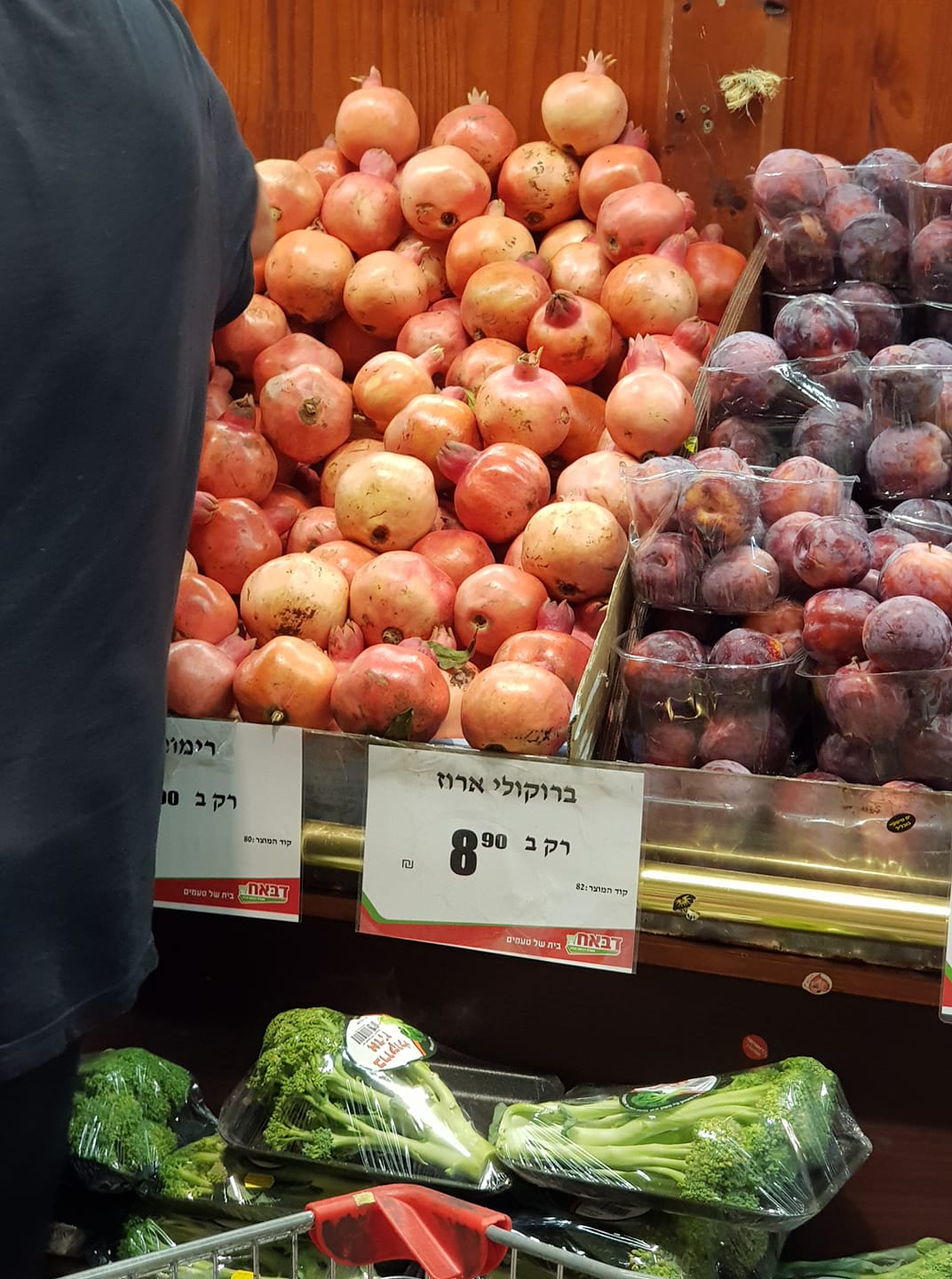
I went to grab the things I needed for shabbat a day early. I wasn’t in the mood for the Friday morning prep mob. I chose to go to a Arab store called דאבח (phonetically) DAY-bach.

This Arab store always have the best of everything. Best variety of fruits and vegetables and shelf stable foods.

So as I get to the produce section I notice the רמן pomegranates are already on the isle, so….I’m looking around for figs and there are none.

Yes, just another confirmation of the biblical month we will be entering in a few more days.Place: Migdal, Israel (32.840697165563, 35.497409788276)Address: Migdal, IsraelI went to grab the things I needed for shabbat a day early. I wasn’t in the mood for the Friday morning prep mob. I chose to go to a Arab store called דאבח (phonetically) DAY-bach.

This Arab store always have the best of everything. Best variety of fruits and vegetables and shelf stable foods.

So as I get to the produce section I notice the רמן pomegranates are already on the isle, so….I’m looking around for figs and there are none.

Yes, just another confirmation of the biblical month we will be entering in a few more days.Updated Aug 13, 2020, 6:23 PM

Aug 12, 2020, 5:31 PM – Becca Biderman shared a link to the group: In search of His ancient and true path …from cover to cover.

https://www.youtube.com/watch?v=q5g7EV2fgJwAsher is sharing his land knowledge with me. As you all know if you’ve been with me a while. I love foraging the land. In the green season, there are so many edible plants it boggles the mind. There’s one plant that’s always fascinated me. I was told it was toxic so I’ve always made a wide path around it. It’s commonly known as a Spitting Cucumber. Here are it’s other names: **Scientific name: Ecballium elaterium *(L.) A.Richard*Common name: Squirting cucumber,Exploding cucumber, Wild Cucumber, Wild Balsam AppleHebrew name: ירוקת החמור Arabic name: قثا الحمارPlant Family: Cucurbitaceae, דלועיים

**In Hebrew **ירוקת החמור **means The Green Donkey. When the cucumber is ripe it explodes and spits its seeds away from the fruit.

So, contrary to what is in print these are not toxic, they are very acidic, but not toxic….Southerners think of wild Poke and the bellyache/runs you get if you don’t pour off the first boil. Same thing here.

Here’s what’s fascinating. Not only does Asher eat them after he soaks them in water but he feeds them to his sheep. He says they cause the ewes to have twins and triplets. He also says it’s antifungal and he uses it as a salve for his sheep when they are injured.

I LOVE this stuff.

The video shows an exploding cucumber.

In the video, the cucumbers are being squeezed but they explode when they are ripe and don’t be to be squeezed.

https://www.youtube.com/watch?v=q5g7EV2fgJwUpdated Aug 13, 2020, 5:05 AM

Aug 12, 2020, 2:50 PM – Becca Biderman shared a link to the group: In search of His ancient and true path …from cover to cover.

https://www.haaretz.com/archaeology/flint-sickles-prove-grain-cultivation-in-galilee-23-000-years-ago-1.5436385?v=1597232527862Ohalo II would be exactly beside Beit Yerach for those of you who saw that new moon Youtube video on the Ancient Path New Moon channel. Here is the text because the article is a Premium payout article in the subscription service. I’ll include the link, it has GREAT photos but I’m guessing it won’t work unless you pay for the service.

Agriculture is believed to have dawned around 12,000 years ago, in the Levant or southern Turkey. Now remains of a [23,000-year-old camp](http://www.haaretz.com/jewish/archaeology/1.667258), including flint sickle blades and extraordinarily preserved botanical remains, found on the shore of the Sea of Galilee throws back the start of cereal cultivation by thousands of years.
* **[Archaeologists Find 780,000-year-old Remains of Prehistoric Man’s Meal ](https://www.haaretz.com/archaeology/MAGAZINE-780-000-year-old-remains-of-plant-diet-found-in-israel-1.5469914)**
* **[A Neanderthal Saw a Pretty Rock and Collected It, Archaeologist Suggests ](https://www.haaretz.com/archaeology/a-neanderthal-collected-rocks-archaeologist-thinks-1.5486851)**
* **[Ancient Judean Jar Handles Prove the Earth’s Magnetic Field Won’t Kill Us All ](https://www.haaretz.com/archaeology/ancient-judean-pottery-proves-the-magnetic-field-won-t-kill-us-1.5433753)**

Analysis of the [sheen on the flint blades](http://journals.plos.org/plosone/article/file?id=10.1371%2Fjournal.pone.0167151&type=printable), and of the seeds proves that the Paleolithic inhabitants of the site called “Ohalo II” lived a chiefly hunting-gathering-fishing lifestyle, but were indeed growing wheat and barley.

[Remains of food grains](http://lecturers.haifa.ac.il/en/hcc/dnadel/Documents/Nadel%20et%20al%20Ohalo%202012.pdf) had been found previously at the site, as had a grinding stone. Now the tools to harvest the grains have been found.

So cereal growing clearly goes back at least 23,000 years, but Prof. Dani Nadel of the Zinman Institute of Archaeology at the University of Haifa declines to state that “agriculture” does.

Asked for the distinction, he explains, “Most people feel that agriculture is much more complex, that it is central to the economy, that everybody was geared into it. Here we have evidence for small-scale auxiliary cereal growing.”

Open gallery view📷The Sea of Galilee: The inhabitants of Ohalo II lived on its shores 23,000 years ago, subsisting on hunting animals, fishing, gathering a ton of plants – and deliberately growing grain. Credit: Gil Magen

The Ohalo inhabitants clearly collected a lot from nature, both plants and animals, he elaborates. “These grains they grew would have augmented their hunter-gatherer diet, which consisted mainly of fish from the lake, animals they hunted or scavenged, birds,especially water fowl, and plants,” says Nadel. “Cereal cultivation was just one of many strategies they had. Their eggs were not all in one basket. They would have tried all sorts of things.”

**Cutting grasses with stone sickles**

The prehistoric camp was discovered by archaeologists when the water level in the Sea of Galilee fell to a low point in modern times, thanks to drought and over-exploitation of the lake and rivers feeding it by Israel and Syria.

Immersion in the lakewater and protection by silt preserved the [oldest-known remains of brush huts and grass bedding](http://lecturers.haifa.ac.il/he/hcc/dnadel/Documents/Nadel%20Ohalo%20dwellings%202003.pdf?Mobile=1&Source=%2Fhe%2Fhcc%2Fdnadel%2F_layouts%2Fmobile%2Fview.aspx%3FList%3D4df8167e-053c-4f74-be4f-288460f9b803%26View%3D6dbd8cb5) known in the world (discovered in 1989), wooden tools (eight, of uncertain use, reported in 2005), food remains, and beads made of shells from the Mediterranean Sea.

The excavators also found a lot of stone tools, including sickle blades that were used to harvest grain. It is the carbon-14 dating of the charred grains and plant remains that led to the date of around 23,000 years.

Open gallery view📷Flint sickle-blade from Ohalo II, dating to about 23,000 years agoCredit: Iris Groman-Yaroslavski and Dani Nadel
##

The five sickle blades found at Ohalo II have a sheen created by their use to cut grasses, and from the hands holding them, says Dr. Iris Groman-Yaroslavski of the Zinman Institute of Archaeology at the University of Haifa. Use-wear analysis of the veneer indicates that while they were used, they were not used much, she explains: That supports the thesis that cultivated, harvested grain was a supplement to their main diet of hunted and gathered foods and fish.

We do know though that their cultivation of grain was not a one-off event.

While the morphology of the grains hardly changed, a high percentage of the dispersal units composing the grain ears were well beyond the standards of wild cereal stands. There were also numerous species, and large numbers, of what would come to be called typical pest weeds in cereal fields, explain Bar-Ilan University botany archaeologists Ehud Weiss and Ainit Snir.

**Oldest known brush huts in the world**

In 1999, Nadel and the botanist Ella Werker published a paper on the [discovery of brush huts at Ohalo II](https://www.researchgate.net/publication/262726781_The_oldest_ever_brush_hut_plant_remains_from_Ohalo_II_Jordan_Valley_Israel_19_BP). Ultimately the remains of six such huts were found at the site, with hearths outside. (The proximity of brush huts and control of fire probably explains why the huts burned down, evidently more than once.)

Open gallery view📷Remains of oval and kidney-shaped 23,000-year old brush huts on the banks of the Sea of Galilee.Credit: Iris Groman-Yaroslavski and Dani Nadel

Architectural perishable remains from the Upper Paleolithic (45,000 to 20,000 B.C.E.) are beyond rare, and are usually identified by concentrations of bones, tools and waste, and sometimes the remains of hearths. At Ohalo II, the archaeologists found the remains of the huts, the fireplaces, a shallow grave with the complete body of a disabled man, who had to have been cared for, and what seems to be a garbage dump.

The huts had burned down before the camp was submerged, but their charred remains remain. Reconstruction based on the identified botanical remains, ethnographic precedent and horse sense shows hut-building hasn’t changed in 23,000 years.

They were not small – one was oval in shape and almost 15 feet long; some were kidney-shaped. The base of the hut floors were some 20 to 40 centimeters below ground level: analysis of the charred wall remains shows they were made of grasses and branches, including salt cedar, oak and willow.

The archaeologists found no evidence of post-holes in or near the huts. They seem to have been constructed by sticking long branches into holes in the ground, a technique still used by hut-builders today.

Lastly on the huts, perhaps brooms hadn’t been invented yet. Their floors were littered with bones, mainly of fish and gazelle but of birds too, ground stone tools and fragments, and thousands of flint flakes, blades and well-shaped tools, indicating that knapping happened there.

Open gallery view📷One of five flint sickle-blades from Ohalo II, showing glossing that fades from the edge, from about 23,000 years ago.

Happily, among the litter on the floor were remains of seeds and fruits – and in one case a large basalt stone that had been used to grind wild grasses, based on starch-grain analysis and the seeds found around it. Among other things, the ancients around the Sea of Galilee were eating pre-domesticated barley, wheat, goat grass, and oats, among others.

So did cereal cultivation begin at least 23,000 years ago, not more recently as thought? Was the Galilee aswarm with early -farmers? We cannot know, but we can say that hunter-gatherers living on the shores of the Sea of Galilee occupied their camp on a year-round basis, and cultivated cereals.

Open gallery view📷Micrograph of 23,000-year-old flint sickle blade, showing the sheen of use to harvest semi-ripe cereal and prehension polish, from Ohalo II, by the Sea of Galilee. Credit: Iris Groman-Yaroslavski and Dani Nadel

Open gallery view📷Micrograph of 23,000-year-old flint sickle blade, showing the sheen of use to harvest semi-ripe cereal and prehension polish.Credit: Iris Groman-Yaroslavski and Dani Nadel

Open gallery view📷A Neolithic form of sickle, built of sharpened flints fitted into a handle, which could be made of wood or bone. Credit: Wolfgang Sauber, Wikimedia Commons
https://www.haaretz.com/archaeology/flint-sickles-prove-grain-cultivation-in-galilee-23-000-years-ago-1.5436385?v=1597232527862Updated Aug 12, 2020, 2:50 PM
Aug 12, 2020, 12:49 PM – Becca Biderman posted in In search of His ancient and true path …from cover to cover.

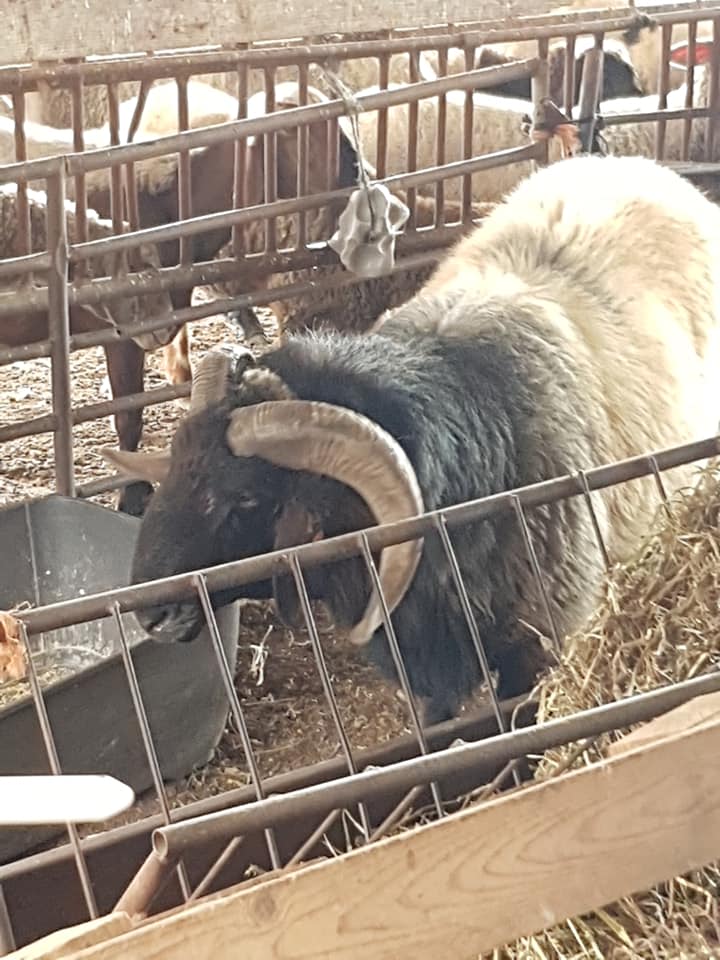
Today I helped John cut metal rails to extend to roof of the pole barn by about a meter. Asher said when it rains the water comes in and makes mud the sheep end up standing in. He also said that he would like us to know how to milk the sheep in case he is ever sick. Yippee, this is a huge element of trust.

The text at the end of the video was cut off sorry…that should say: Asher played a joke on John. He told John to milk a certain sheep. John reached in and grabbed testicles….this is farm humor on city people 😂. I told Asher after one this time John would look before he grabs. Asher cracked up.Today I helped John cut metal rails to extend to roof of the pole barn by about a meter. Asher said when it rains the water comes in and makes mud the sheep end up standing in. He also said that he would like us to know how to milk the sheep in case he is ever sick. Yippee, this is a huge element of trust.

The text at the end of the video was cut off sorry…that should say: Asher played a joke on John. He told John to milk a certain sheep. John reached in and grabbed testicles….this is farm humor on city people 😂. I told Asher after one this time John would look before he grabs. Asher cracked up.Updated Aug 13, 2020, 6:05 AM

Aug 12, 2020, 7:14 AM – Becca Biderman posted in In search of His ancient and true path …from cover to cover.

Please pray for Asher. Today is the first day that I will be working on his sheep farm. Please ask the Father to open Asher’s eye and that he’s curious about this strange Believer that comes to help out; enough so that by his curiosity Asher ‘accidentally’ finds his Mashiach.

You may not realize this until this moment because I may never have fully expressed what I’m about to tell you.

I truly and honestly believe the reason that I’m being reconnected to the Biblical calendar to such a degree is so that I can reconnect Judah to the Ancient Path rather than the rabbinical writing they follow. Specifically, I was told by Abba: it won’t be the things that I say but the way that I live my life. (More on this later).

You all are just a wonderful added bonus.Updated Aug 13, 2020, 7:09 PM

Aug 11, 2020, 1:20 PM – Becca Biderman posted in In search of His ancient and true path …from cover to cover.

I’m starting to see pomegranate trees that are ready. I’ve been watching this specific tree since I drive by it regularly. Last week none of the fruit had dropped.I’m starting to see pomegranate trees that are ready. I’ve been watching this specific tree since I drive by it regularly. Last week none of the fruit had dropped.Updated Aug 11, 2020, 6:14 PM

Aug 9, 2020, 3:41 PM – Becca Biderman posted in In search of His ancient and true path …from cover to cover.

Ya know, my epiphany this week is the calendar of Elohim is not quite the mystery I use to think it was when I only looked to the wild barley. It’s really quite clearly and plainly demonstrated on the land practically the entire 12 months of the year. Think about it. Even in the 11th and 12th month we are already watching for the lambs now that we understand they are entering their breeding season in the sixth month and will give birth in five months time. I just love watching Elohim’s timeline.Updated Aug 11, 2020, 2:17 PM